
Chianti Against Brunello at the Festa della Toscana
Wine Curator
WSET Diploma · Vivino Top 50 reviewer, Australia
Published · Last reviewed
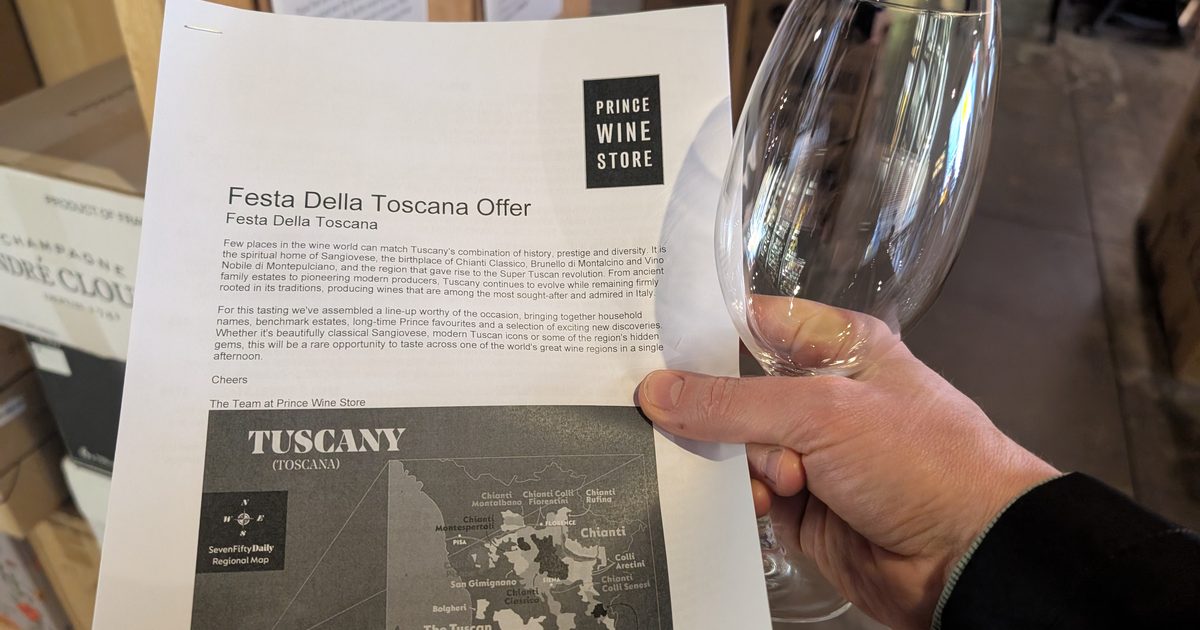
Prince Wine Store normally puts its big Italian tasting of the year into the Festa del Barolo, the Melbourne celebration of Piedmont. This year they went to Tuscany instead, and the invitation described it as a short detour. The ticket was $50, which is five times the $10 their Saturday tastings normally ask, and the money bought a longer list and a table of charcuterie and cheese. I went on Saturday 29 August and worked through thirty-two wines.
Every price below is the shelf price printed on Prince's own offer sheet for the day. There was a lower price on each wine for anyone buying at the tasting, and I have used the shelf figure throughout so the comparisons hold against what you would pay walking in on an ordinary afternoon.
It was not really a Tuscan tasting
Tuscany is a wide region and it makes several quite different things. There is Chianti Classico and the appellations around it. There is the more serious traditional Sangiovese of Brunello di Montalcino and Vino Nobile di Montepulciano. There are white wines, of which Vernaccia di San Gimignano is the one with a reputation. There are the Super Tuscans, some built on Sangiovese and some on Bordeaux varieties. There is Vin Santo, the region's sweet wine.
What actually got poured was narrower than that. Fourteen of the thirty-two wines were Chianti in one form or another, and six came from Montalcino. Vino Nobile di Montepulciano was represented by a single bottle from Boscarelli. The Tuscan coast was represented by a single bottle too, the Grattamacco Bolgheri Rosso. The whites were two entry-level wines sitting at the two cheapest prices on the sheet, and there was no Vin Santo at all. The invitation had promised the Super Tuscan revolution by name. Three Sangiovese wines in that tradition did turn up, including the Felsina Fontalloro and the Poggio Scalette Il Carbonaione. The Bordeaux side of it was thinner. The two wines the invitation actually listed, Brancaia Il Blu and Cignale, reached neither the offer sheet nor my glass, which left the Grattamacco as the only Bordeaux-led bottle in the room.
So it played as a Chianti against Brunello match rather than a tour of Tuscany. That is a good match to watch, and I will come back to who won it. It is just not what the invitation described. Prince had also run a Chianti Classico tasting three months earlier, on 16 May, for $10 refundable against a $100 purchase. Five producers turned up at both. By half past one the room had thinned out considerably.
Montalcino won, and it earned it
Montalcino is a hill town in the province of Siena, about a hundred and ten kilometres south of Florence, and it is drier and hotter than the Chianti Classico hills. Brunello is the local name for the Sangiovese grown there, a diminutive of bruno, and for a long time it was thought to be a variety of its own. The rules are younger than the reputation suggests. Brunello di Montalcino was among the first Italian wines to be given DOC status in 1966, and in 1980 it became the first in the country to be promoted to DOCG. Those rules are demanding about time: a Brunello cannot be sold until four years after the harvest, and at least two of them have to be spent in wood.
The tasting made the case for the place about as clearly as a tasting can. Four of the six wines I put at the top of my sheet came from Montalcino, and those six wines cost on average more than twice what the other reds in the room cost. I cannot explain that away as coincidence.
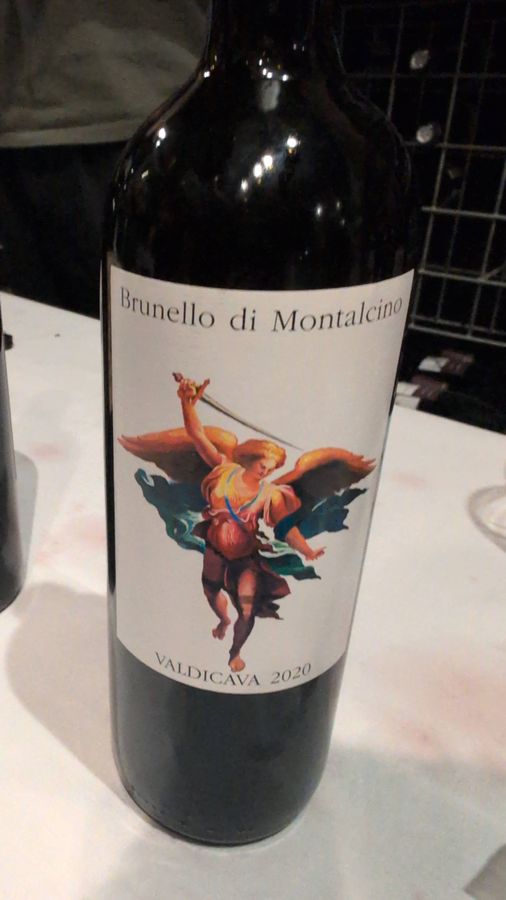
Valdicava Brunello di Montalcino 2020
At $208 it shared the top of my sheet with the Uccelliera Brunello at $153. Both were layered and complex, with tannins that were fine and long rather than heavy, and the Talenti 2020 came in just behind at $140, smooth and balanced and very easy to like. The label deserves a word of its own. It carries a painted archangel with a raised sword across the whole front, in full colour, and it is the most memorable label I saw all afternoon.
One price is worth pausing on. The Fuligni Brunello 2020 was the most expensive wine on the sheet at $263, and it did not come out ahead of the Uccelliera at $153. It is a lovely wine and I would not argue with anyone who preferred it. It just did not buy me anything for the extra $110.
Montalcino is not new to me. A few of its wines are already on the site, including Soldera Case Basse and Pian delle Querci.
One caveat, which I would rather state than bury. The Chianti wines were mostly 2023 and the Montalcino wines mostly 2020, because Brunello is not allowed out for four years. So I was tasting settled wine against current release, and some of what I am crediting to Montalcino may just be those three extra years.
The Riserva bottles did not pay
The thing that did not survive the afternoon was the ladder inside each producer's own range. Three estates poured me both halves of it, the basic wine and the Riserva above it, which spends longer in wood and costs more.
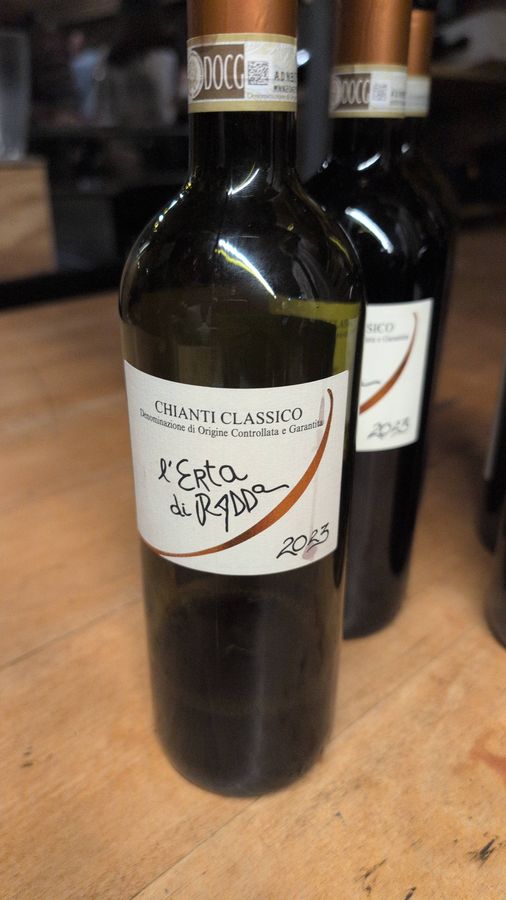
- L'Erta di Radda poured a Chianti Classico 2023 at $67 and a Riserva 2021 at $119. I could tell these two apart easily. The Classico was all fruit purity, and the Riserva had layers built on top of it, so this was the one pair where I could feel what the extra money was for. On the day the Classico was still the better drink.
- Villa Le Corti poured a Chianti Classico 2023 at $44 and the Cortevecchia Riserva 2021 at $63. The Riserva came out below the cheaper wine, and my note on it reads "big oak on the nose".
- Fattoria Selvapiana poured a Chianti Rufina 2024 at $45 and the Bucerchiale Riserva 2012 at $208. That is twelve extra years and $163 extra, and again I could not separate them.
Three pairs is not much to go on, so I checked them against the Chianti tasting in May, where five more producers showed a basic wine beside a Riserva or a Gran Selezione. Across all eight pairs the L'Erta was the only one where the step up plainly gave me something, and even there the cheaper bottle was the better drink on the day. Le Cinciole shows the usual pattern most plainly. Their Chianti Classico and their Gran Selezione Aluigi scored the same in May, and the Aluigi costs about twice as much.
I want to be careful about what that does and does not mean. A Riserva is built to last longer, and I tasted these young, so I am measuring the wrong thing if longevity is what you are buying. But if you are opening the bottle within a few years, the extra ageing rarely showed up in my glass in a way I would pay for, and by my palate the base wines were the better proposition on the day.
The three I would actually buy
The Brunellos were the best wines in the room and they are not what I would carry home. Three bottles sat in a different place, where the price and the pleasure lined up, and those are the ones I marked on the day.
L'Erta di Radda Chianti Classico 2023
At $67 it scored level with the Talenti Brunello at $140. It is delicate and fruit-driven with real length, and it was the only wine that finished in my top six and was also one of the three I marked to take home. This is a small estate in Radda, and it put two wines in that top six.
The Le Cinciole Chianti Classico was the second, at $50, with good balance and good complexity. I had tasted the same wine at the May tasting and came out in the same place, which is about as close to a repeat as tasting gets.
The third was the Querciabella Mongrana at $35, from the Maremma on the coast rather than from Chianti. It is well made and easy to drink without being simple, and it was the second-cheapest red on the sheet. The same producer's Chianti Classico scored lower for me back in May at a higher price.
None of those three is a bargain-hunting story, because the expensive wines really did score higher for me, and I have said so. The point is narrower than that. Crossing from Chianti to Montalcino bought me something I could taste. Climbing the ladder inside a Chianti estate, from the basic bottle to the Riserva, did not. If you are spending $100 on Tuscan wine, my afternoon says put it into a different appellation rather than into a longer word on the same label. If you would rather have that work done for you, my 60-second quiz reads your palate from the styles you already drink and matches you to bottles I have tasted and rated myself.
Not sure where to start? The quiz matches wines to your taste.