
Beautiful and Expensive: Robert Weil at Rathdowne Cellars
Wine Curator
WSET Diploma · Vivino Top 50 reviewer, Australia
Published · Last reviewed
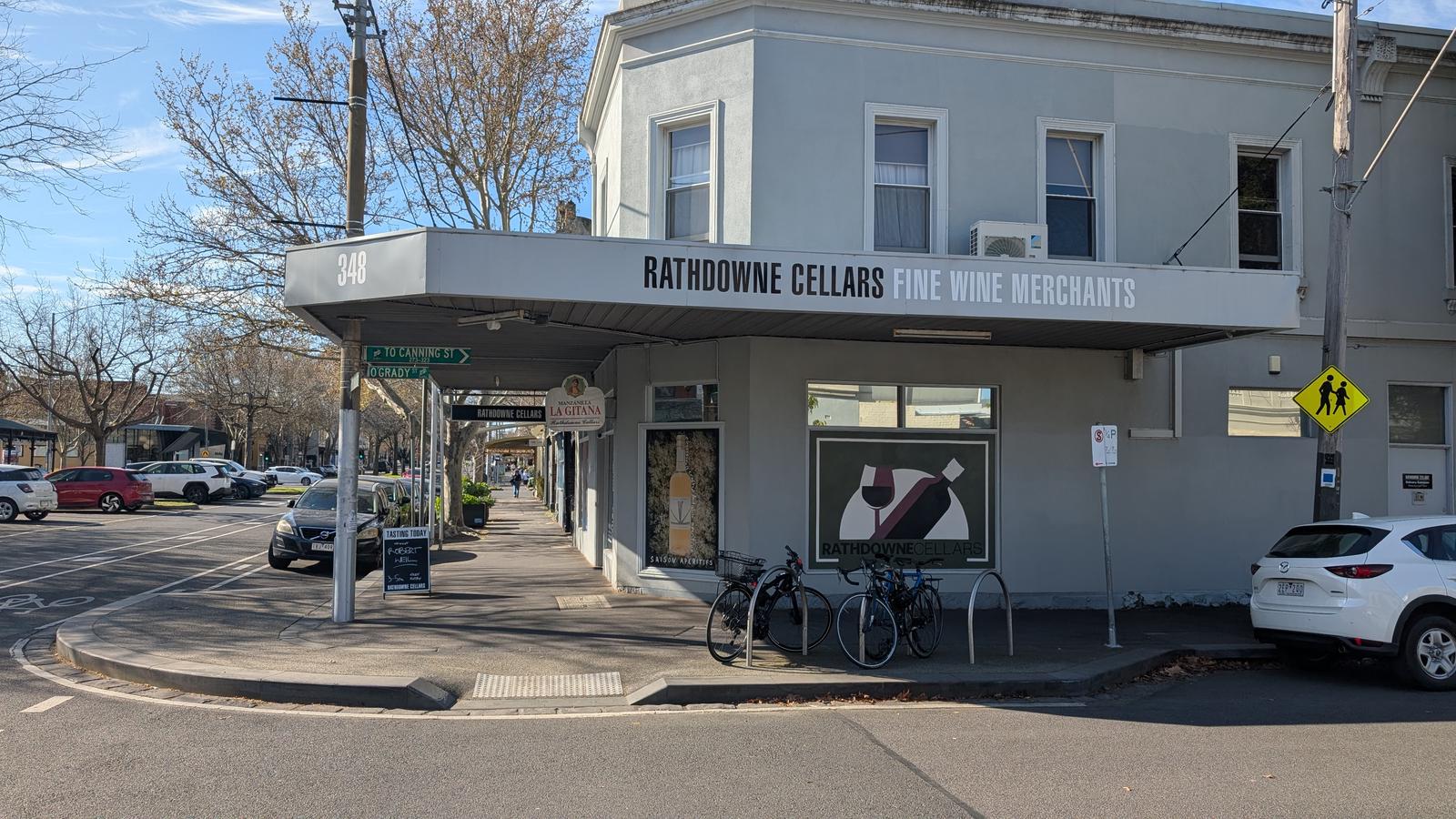
Rathdowne Cellars is one of my local wine stores. It is a lovely shop with a tight collection, and I especially enjoy the sherries there. It is also a great place to pick up a bottle if you are having dinner at one of the BYO restaurants on Rathdowne Street.
They run occasional tastings on Saturday afternoons, and they are free. The format is usually a single producer and four to six wines. The shop does not really pour itself. It leaves that to the importer or to someone from the winery.
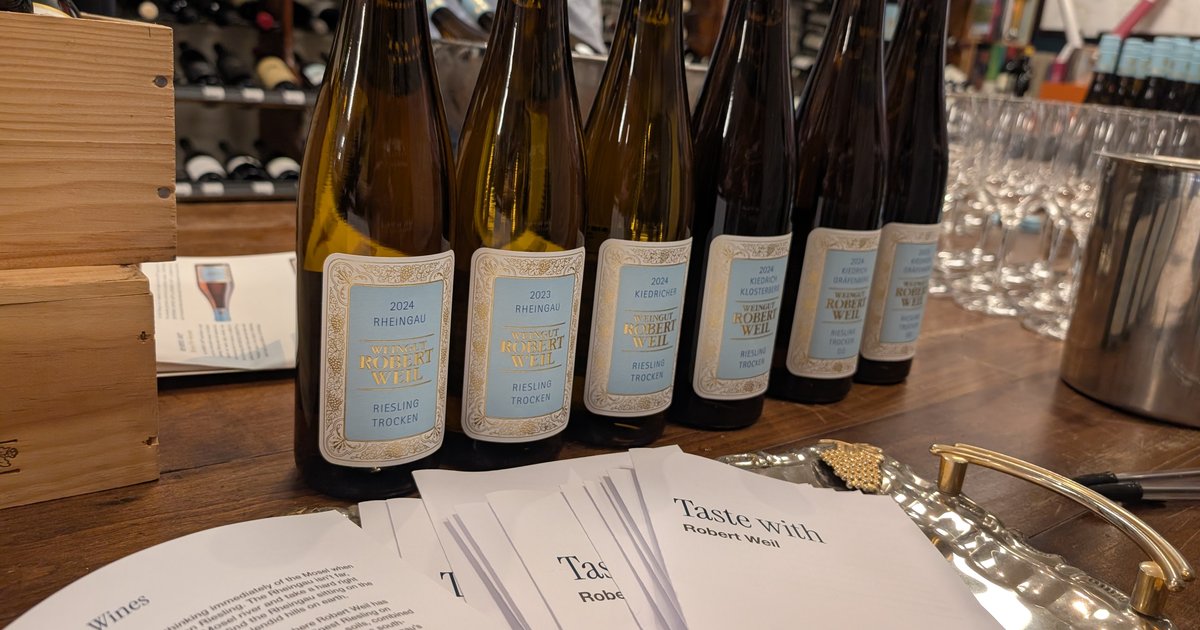
On Saturday 12 September it was Weingut Robert Weil, from Kiedrich in the Rheingau, and the wines were poured by Julius Paetzold, the estate's export manager. All 90 hectares are planted to Riesling and farmed under organic certification. The estate makes sweet Riesling as well as dry, all the way up to Trockenbeerenauslese, but everything on the table that afternoon was dry, and the alcohol sat at a moderate level throughout. They also poured two of the wines in two vintages each, which turned the lineup into a pair of small flights.
Four steps up the ladder
The lineup climbed the classification of the VDP, the association of German estates that Weil belongs to. At the bottom is the estate wine, the Rheingau Riesling Trocken. Next comes the village wine, the Kiedricher Riesling Trocken, from the estate's Kiedrich hillside vineyards. Then comes a single vineyard classed Erste Lage, the Kiedrich Klosterberg, which is roughly the equivalent of a premier cru. At the top is the Kiedrich Gräfenberg, their Grosse Lage, and the dry wine from a Grosse Lage is the one that carries the letters GG. That is the association's equivalent of grand cru.
The two Rheingau Riesling Trockens, the 2024 and the 2023, were both already quite rich, and the quality is great for the estate's entry-level wine. They were also technical and quite predictable, and I scored the two vintages identically. That is why the wines above them shone more for me.
The Kiedricher 2024 and the Klosterberg 2024 had more structure and more precision, and the acidity stepped up with them. My notes move from lemon and green apple on the entry wines to grapefruit, lime, white peach and white flowers higher up. The Klosterberg in particular opened softly and then moved into a steely structure, and it was a great wine.
The same wine, one year apart
The Gräfenberg GG was poured as the 2024 and the 2023, side by side, at the same $195 on the shop's order form. Both were exceptional wines, but I much preferred the 2023. The 2024 had good structure and balance, and it felt closed and not ready. The 2023 had great complexity, it was very layered, and it kept showing more as the tasting went on. It was the best wine of the afternoon for me, and the gap between the two was the biggest step I recorded between any two wines poured one after the other.
At $64 the one-year gap between the two entry wines made no difference to my scores. At the top of the hill the same year made the biggest difference of the afternoon. My reading is that the extra year only starts to count once a wine has the structure to use it. Most of the time you taste a young GG with nothing to compare it against, and this tasting put a bottle one year older on the same table.
Beautiful, and expensive
One thing connected all six wines. They are beautiful, but they are expensive, and at the top they are very expensive. I found everything overpriced, even though the wine I wanted to take home was the Gräfenberg 2023. Both of those things are true at once. You can rate a wine highly, want it, and still think the shelf price is wrong.
The order form
The shop's prices ran from $64 for either vintage of the Rheingau Riesling Trocken to $80 for the Kiedricher, $110 for the Klosterberg and $195 for each Gräfenberg GG.
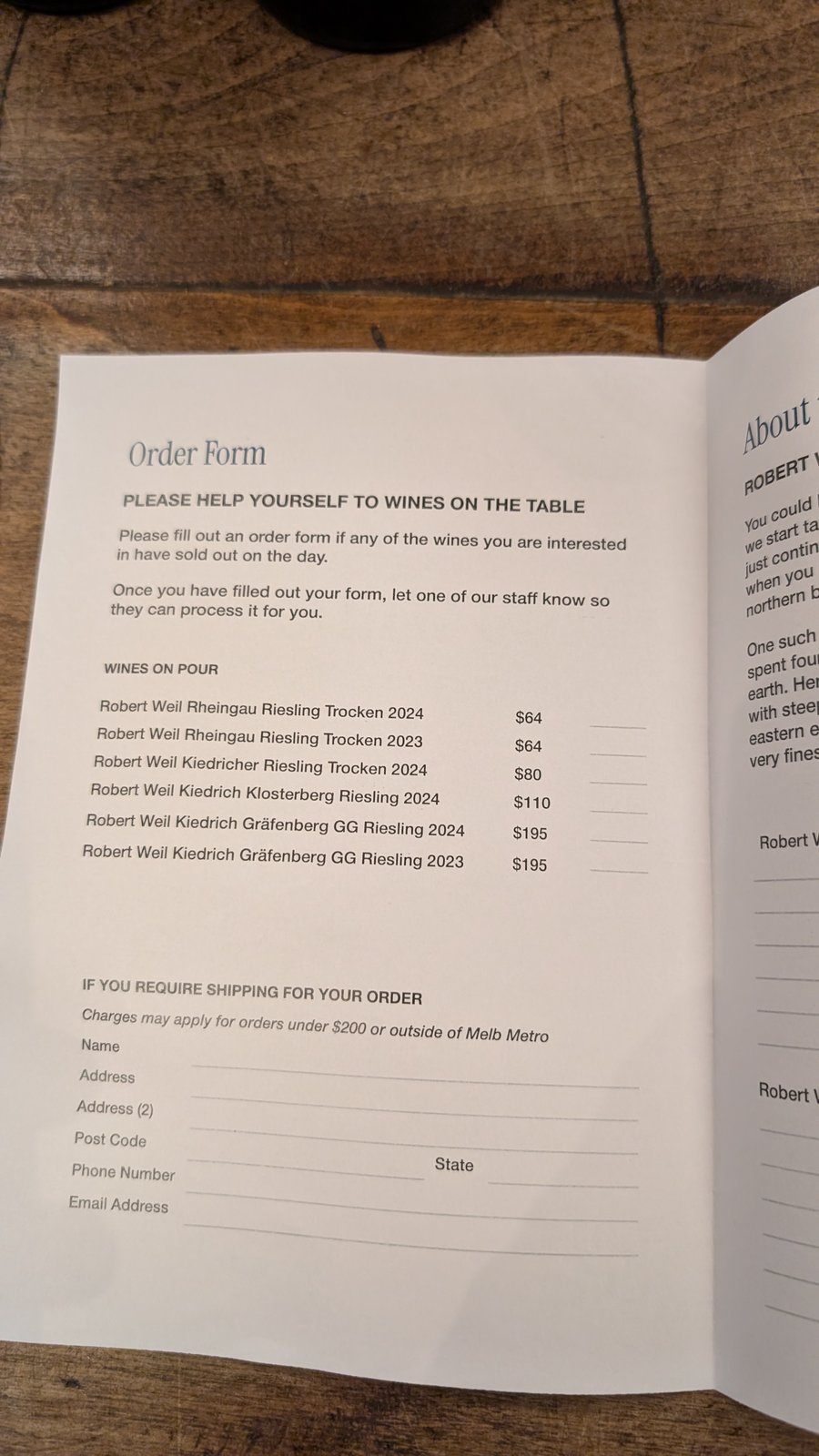
So I looked more closely at where the price comes from. There are three suspects: the shop, the Australian market for German wine, and the producer.
It is not the shop. Its prices are in line with what another Australian retailer charges for the same wines.
What about German Riesling in general? My own records say it is expensive here at the top end. Three Dr. Loosen Alte Reben GGs I tasted in March 2025, the Ürziger Würzgarten, the Erdener Treppchen and the Wehlener Sonnenuhr, are listed at $91 to $110. The same producer's Unterst Pichter Réserve GG is $245, and the Bürklin-Wolf Langenmorgen G.C., the dry German wine I have scored highest, is $291. At $195, the Gräfenberg sits inside that range rather than above it.
None of that makes the Gräfenberg 2023 a lesser wine, and if you get the chance to taste it, take it. Top German Riesling is expensive in Australia, and Weil's is no exception. It is still a bottle worth enjoying, as long as you know that going in.
None of Weil's wines are in my catalogue, but the German Rieslings above are. If you want to know whether this style would suit you, my 60-second quiz works out your palate from what you already drink and matches you to bottles I have tasted myself.
Not sure where to start? The quiz matches wines to your taste.