
A Second Look at Whistling Eagle
Wine Curator
WSET Diploma · Vivino Top 50 reviewer, Australia
Published · Last reviewed
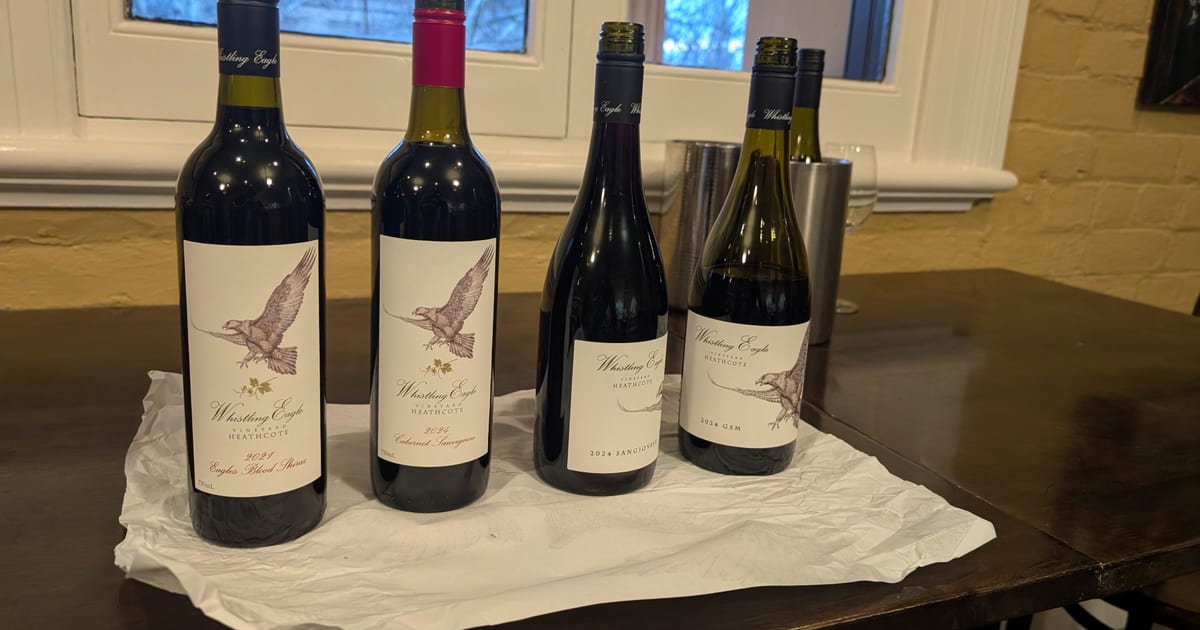
I have been drinking Whistling Eagle wines for years without ever properly tasting them. A glass at an event here, a bottle passed around there. Enough contact to form an opinion, never enough to test one. That is how most of us arrive at a verdict on a producer, and it is a bad way to get there.
In August I sat down in Bendigo and worked through five of their wines in order, white through to the flagship Shiraz, and came out having changed my mind about one of them.
A room full of regulars
Wine Bank on View runs a public tasting every Wednesday from 5:30. Ten dollars if you are not a member, refunded against any bottle you buy on the night, and a different winery each week. It sits at 45 View Street in a Victorian bank building from 1876, which is a better room than most wine shops have to work with.
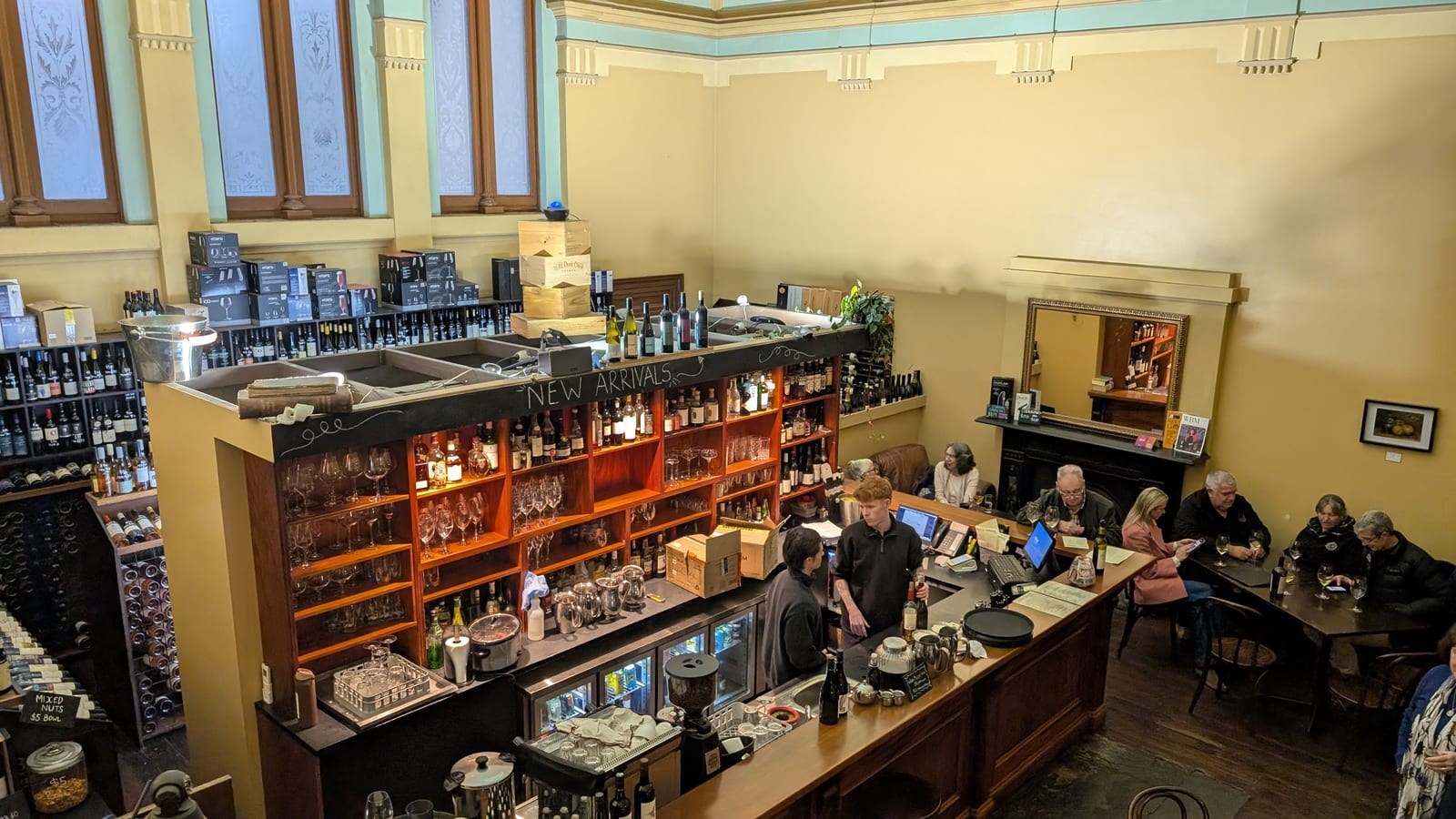
The format is the opposite of the Saturday walk-arounds at Prince Wine Store. That one is a big affair: several tables, twenty wines, a crowd circulating the shop floor. Wine Bank has a dedicated room, the person pouring stands at the front with the bottles, and everyone else sits down.
People arrive whenever they like between 5:30 and 7:30, which turns the evening into a memory game for whoever is pouring. Half the room is on wine two while the other half is on wine five, and the commentary has to be delivered four or five times over.
The bigger difference is that these people know each other. It reads as an evening for the local wine crowd rather than a shop promotion, and a small group has clearly built itself around it. It reminded me less of a retail tasting than of the ones I used to organise with friends, which is a rare thing to find in a room you can walk into off the street.
The producer, briefly
Whistling Eagle sits on the Cambrian soil of the Mount Camel Range in Heathcote, farmed by Ian and Lynn Rathjen. The family's connection to that ground runs deep. Henning Rathjen arrived from Schleswig-Holstein in 1858 and had vines in by the 1860s. Those vineyards disappeared. The current ones went in during 1995, with the first Shiraz made in 1997.
Fourteen varieties across fifty hectares, which is a lot of range for a family operation. The sustainability work is the kind that shows up as labour rather than as a logo on the back label: native flowering trees planted to draw in predatory insects, mid-row plantings of diverse sward including native wallaby grasses.
The five wines
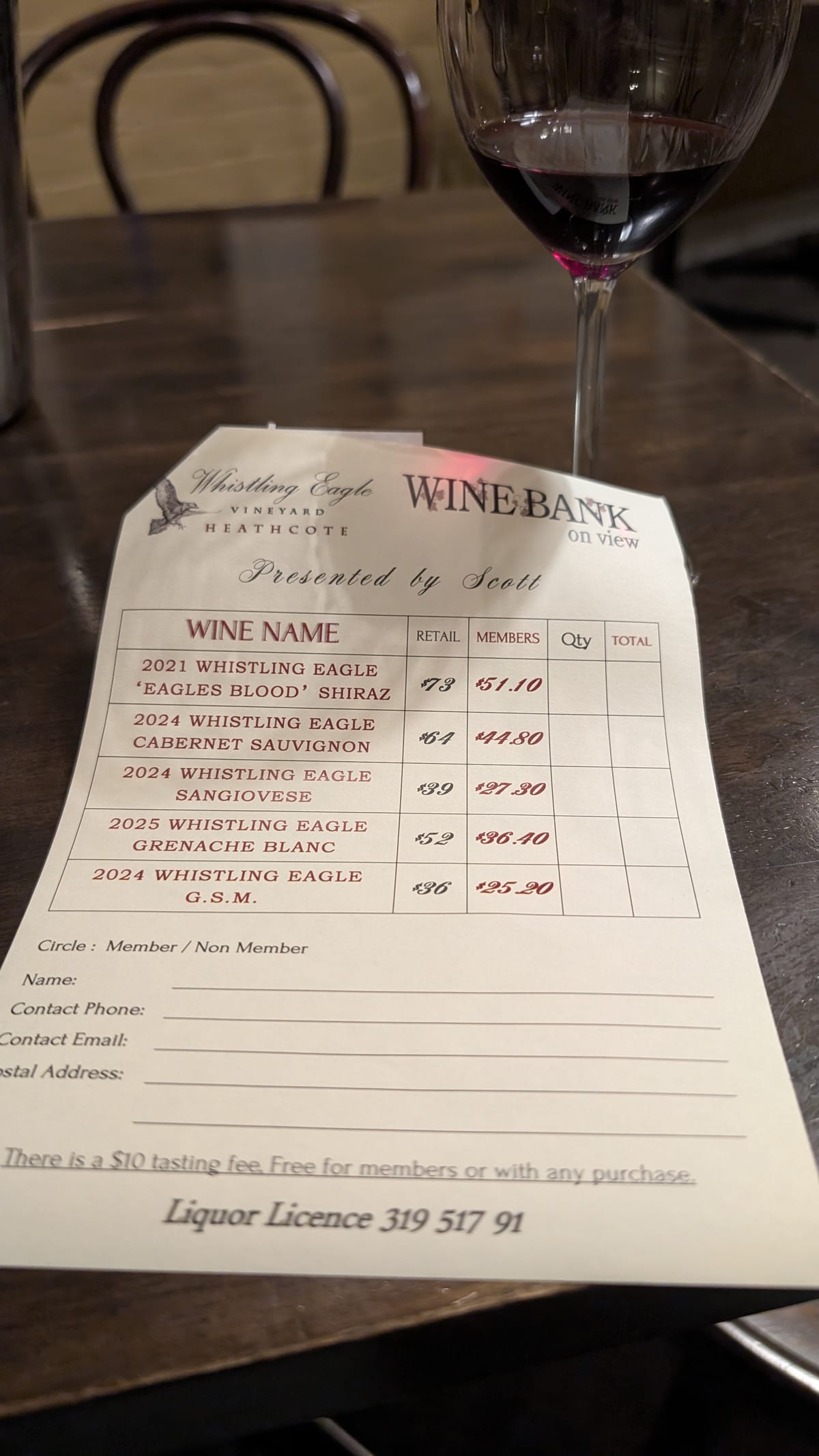
Grenache Blanc 2025
Aromatic and properly structured, more serious than the variety usually gets credit for here. My one reservation is that I expected a little more for what it costs.
GSM 2024
Surprisingly light and lean for the blend, which I mean as praise. There is more complexity here than the price suggests. A great everyday wine.
Sangiovese 2024
The surprise of the night. I tasted an earlier vintage a couple of years ago and scored it 3.7, which is my way of saying good but not memorable. This one I gave 4.2. Delicate and complex, with real structure underneath and long, fine tannins. The best value in the room by some distance.
Cabernet Sauvignon 2024
Very well executed. Rich on the nose, good concentration, and several years away from being ready. If I have a criticism it is that there is nothing much to criticise. Not a mark on it, nothing out of place, nothing that got there by accident. I would still be glad to have it in the cellar.
Eagles Blood Shiraz 2021
My favourite of the night. Complex, soft on the approach, long finish. Holding it back to five years old rather than releasing at two is doing a lot of the work. It reaches the shelf at a point where you can drink it now instead of being told to wait. A top Heathcote Shiraz on any measure.
One voice across five wines
Five wines doing five different jobs, and every one of them sounded like the same producer. Roundness, approachability, and a clear idea behind each.
Whether you read that cleanliness as a virtue depends a lot on where you learned to drink. Plenty of European reds carry a faint barnyard note that comes from a yeast called brettanomyces, and there has been an argument running for decades about whether it is a flaw to be engineered out or part of what gives a wine its character. New World winemaking has largely settled that argument in favour of engineering it out. If that is what you grew up drinking, you will not notice what is absent. I noticed.
What I actually took away
The Sangiovese is the point. I had tasted that wine before, in a room where I was not paying attention, and scored it 3.7. Sat down in sequence, next to its own siblings, it came out half a point higher. The Eagles Blood is still the wine I would rather drink. The Sangiovese is the one I had got wrong.
I bought a bottle of the Sangiovese on the way out.
That is the case for structured tastings, and for cheap local ones in particular. Ten dollars and a Wednesday night buys you the one thing a glass at a party never will: context. One bottle on its own is a data point. It is not a verdict.
If you would rather have that work done for you, my 60-second quiz reads your palate from the styles you already drink and matches you to bottles I have tasted and rated myself. Whistling Eagle's Sangiovese and Arinto are both in there.
Not sure where to start? The quiz matches wines to your taste.